Organisation: Grass Skirt Project
Location: Port Moresby, Papua New Guinea
Type: Not-for-Profit
Founder: Tahina Booth, Founder & Managing Director
Focus: Gender-based violence prevention; youth leadership; safe and inclusive access to sport and physical activity; community-led development
Website: www.grassskirtproject.org
Instagram: @grassskirtproject
LinkedIn: Grass Skirt Project
Summary/Overview
Grass Skirt Project (GSP) is a Papua New Guinean, women-led organisation using sport to prevent gender-based violence and build youth leadership across Papua New Guinea and the Pacific. Founded in 2017, its work is grounded in a belief that communities should not simply participate in development programmes, but hold the authority to shape and lead them.
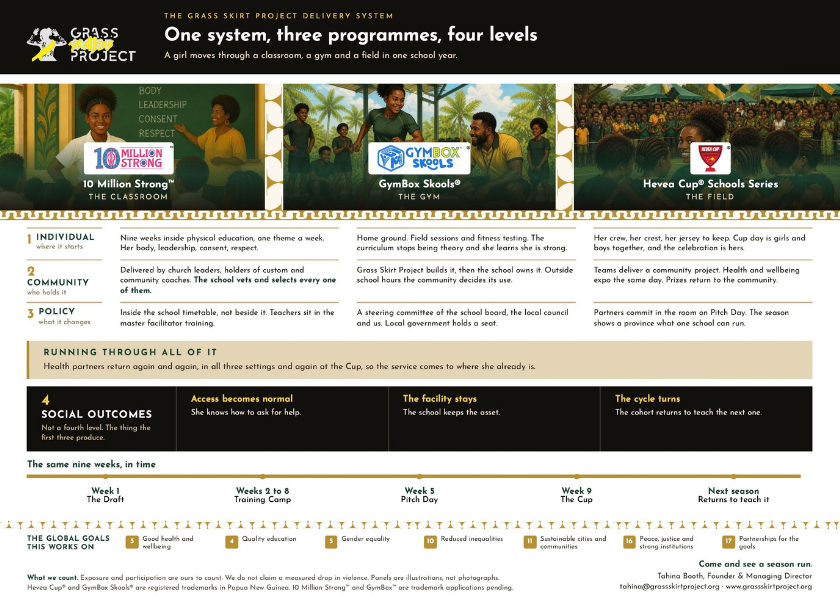
GSP delivers three integrated programmes. GymBox provides container-based community fitness infrastructure in settlements where access to facilities and services is limited. 10 Million Strong is a sport-based gender equality and leadership curriculum delivered through schools, clubs and GymBox spaces. Hevea Cup brings communities together through a rugby league nines tournament combined with a health and wellness festival.
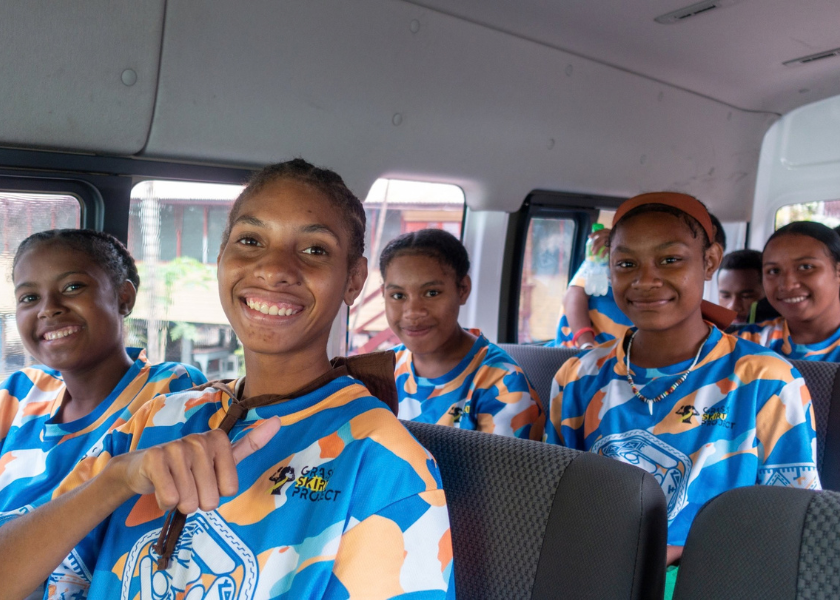
Across these programmes, sport becomes more than an activity. It creates a space in which women can train safely, girls can be recognised as leaders, boys can participate as allies and young people can speak for themselves.
The GSP has also increasingly focused on building evidence around its approach. In 2026, GSP became one of the first sport-for-development organisations in the Pacific to commission a forecast Social Return on Investment (SROI) using an independently reviewed methodology. The forecast estimated USD 7.9 in social value for every USD 1 invested at programme level, and USD 6.0 when all organisational costs are included, between 2026 and 2030. The initiative is also named in the PNG National GBV Strategy 2026 to 2035 as an enabling partner under Pillar 3, Prevention and Social Shifts.
Take Us to the Beginning
Grass Skirt Project began in 2017 against a backdrop of significant gender inequality and high rates of violence against women. More than half of Papua New Guinea’s population is under the age of 25, yet the social and cultural conditions surrounding many young people, particularly girls, often limited whose voices were heard and who was expected to take up public space.
Sport reflected many of these inequalities. Rugby league is Papua New Guinea’s national sport and one of the country’s most culturally resonant forms of sport, yet women only officially began playing it in 2017, the same year GSP was founded.
Before initiatives such as GSP, sporting spaces in the communities were largely perceived as belonging to men. Girls were often expected to keep the peace, remain quiet and avoid drawing attention to themselves. In the settlements where GSP operates, there was also no dedicated space where women could train without being watched.
GSP identified two interconnected gaps. The first was physical: women and young people lacked safe spaces in which they could gather, train and visibly belong. The second was about power and programme design. Communities were frequently approached as beneficiaries of externally designed solutions rather than as authors of their own development.
GSP also questioned approaches that framed boys primarily as the problem and girls primarily as victims. Instead, they sought to work from the knowledge, relationships and courage already present within communities.
For Founder and Managing Director Tahina Booth, one particular moment captured why this mattered. Two young people involved in the programme were speaking with a diplomat about why no one collected rubbish in their village. Their explanation revealed that the young people already understood their community and its challenges.
“The knowledge was never the gap. The framework being imposed on them was the gap. That is why GSP exists, not to arrive with answers, but to create the conditions where young people can speak.”
Creating Safe and Inclusive Environments
GSP’s approach begins with listening. Rather than asking communities to work around the organisation’s timetable or an externally determined model, it follows community rhythms, works with elders and remains accountable to clans.
A central part of this approach is “tok stori”, a Pacific practice of relational dialogue that allows conversations and experiences to emerge in their own time. For GSP, this is particularly important when discussing sensitive issues such as violence, health and rights.
Instead of approaching these topics through lectures, GSP uses sport and relational conversation. Boys are not automatically framed as perpetrators, nor girls as victims. Conversations begin with what communities already know and use language, relationships and settings that are familiar to them.
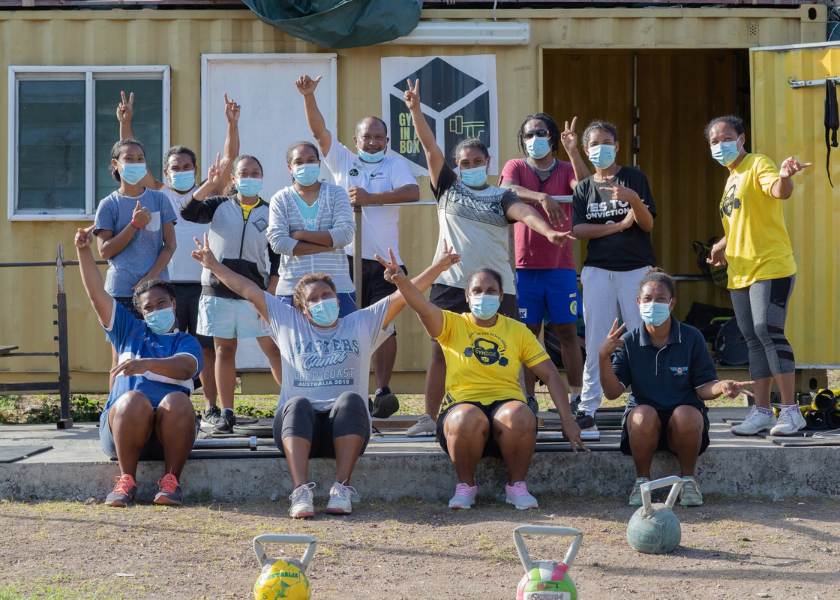
This philosophy is reflected in the organisation’s physical spaces too. GymBox responds directly to the absence of safe and accessible fitness infrastructure in settlements. A shipping container provides a standard physical structure, but the programming surrounding it is co-designed locally. Each community works through its own elders, clans and rhythms, meaning that although the infrastructure can be replicated, its use is not imposed through a single model.
For women, GymBox provides somewhere to train without being watched. Perimeter lighting is also being added to strengthen safety at night. The spaces are free to use and are run by young people themselves.
Schools are increasingly central to this model. Locating GymBoxes on school grounds enables GSP to reach young people through the school day, with a particular focus on state schools serving families with less access to formal facilities and services. The organisation also deliberately reaches women and people with disabilities who might otherwise have limited access to gyms, health services or training.
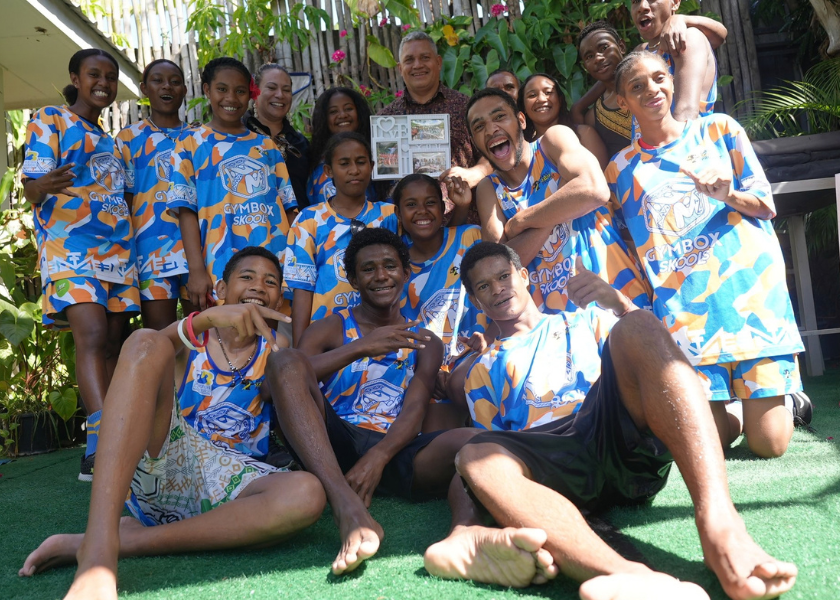
The 10 Million Strong curriculum brings boys and girls together to develop leadership and conflict-resolution skills. Rather than pursuing gender equality by working around boys, GSP involves them directly in the process.
“Boys are not framed as the problem, they are invited back into their role as keepers of peace. Girls are recognised as the leaders the country has been waiting for.”
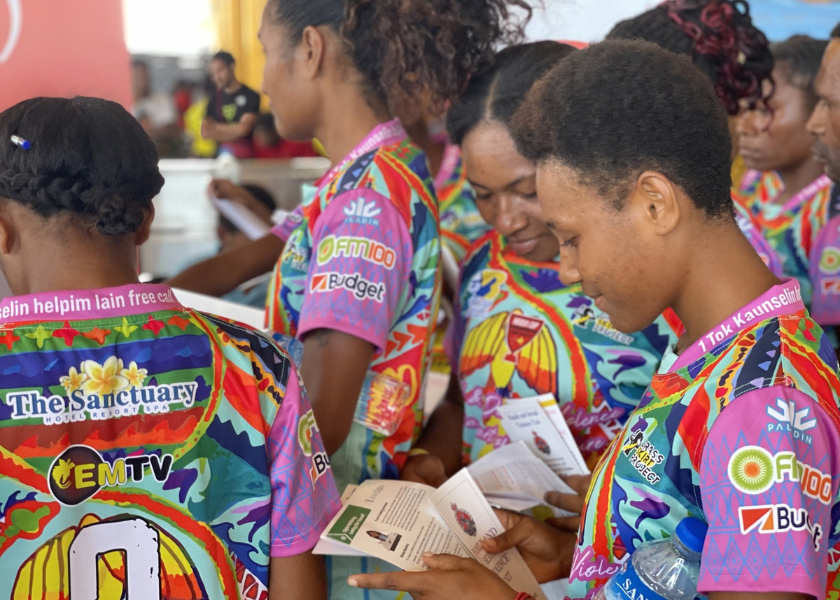
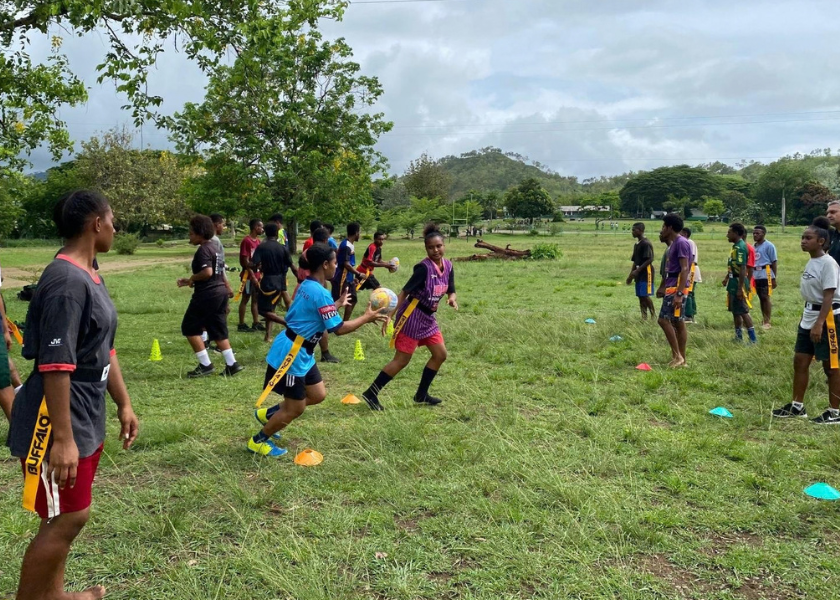
The Hevea Cup extends these conversations into public community life. By bringing women, girls, boys and entire families into rugby league spaces together, the event helps challenge assumptions about who PNG sport belongs to.
Schools, school boards, ward councillors, local members, private partners, community organisations, elders and clans form what GSP describes as a chain of local actors. School boards can host GymBoxes on their grounds and open the school day to GSP programming, while private partners support infrastructure development. The model is intended to ensure that value is created, governed and retained locally.
Outcomes and Evidence
Some of the changes GSP considers most significant are visible in everyday behaviour: young people speaking in spaces where they were previously not expected to speak, women training publicly, girls seeing themselves as leaders and boys standing alongside them as allies.
Young people who initially entered programmes as participants have also progressed to running sessions themselves. For GSP, this represents an important transition from participation towards genuine youth leadership.
“A young person speaking in a room they were never expected to speak in, and someone standing beside them when they do.”
Participation has grown and deepened over time. GymBoxes have operated in Port Moresby settlements for seven years, thousands of young people have participated in 10 Million Strong, and Hevea Cup has brought together clans, schools, settlements and families.
GSP has also observed shifts in attitudes. Girls are increasingly being seen, and seeing themselves, as leaders. Boys are approached as allies and encouraged to take on positive roles within their communities. Communities that once expected girls to remain quiet are beginning to put them forward.
Demand has grown beyond initial expectations. Other schools and communities are now requesting GymBoxes of their own, while the existing infrastructure has taken on functions beyond sport, including serving as a venue for health events and as an everyday safe community space.
GSP’s 2026 forecast SROI, based on an independently reviewed methodology, forecasts a return of 6.0 to 1 across the organisation and 7.9 to 1 at programme level over the period 2026 to 2030.
GSP is careful to distinguish these figures from measured outcomes: they are forecasts rather than completed impact results. For them, developing this evidence base is part of ensuring that locally led approaches can also be understood within the systems through which investment decisions are made.
Being named as an enabling partner under Pillar 3 of the PNG National GBV Strategy 2026 to 2035 represents another significant milestone for the organisation, reflecting recognition of sport as an approach to preventing violence and supporting social change.
Successes and Challenges
One of GSP’s proudest milestones has been the development of the Badihagwa GymBox, built as community-owned infrastructure through local partnerships beside Badihagwa Technical Secondary School.
But some of the moments that best represent their progress are less about infrastructure and more about voice. Tahina Booth recalls two young people from GSP speaking in a room full of diplomats and explaining, respectfully and confidently, why a framework being proposed for their village did not fit their reality.
For GSP, their ability to do this independently embodied the purpose of the work.
At the same time, growth has brought pressure. Demand from additional communities and schools is increasing, while funding available to locally led Pacific organisations remains limited and often short-term. GSP identifies the way international capital reaches Papua New Guinea as a continuing structural challenge, with much of it flowing through international intermediaries.
Evaluation presents a related challenge. The organisation argues that conventional frameworks often position communities primarily as sources of data rather than giving them authority in defining and interpreting what matters.
GSP has had to navigate the tension between building an evidence base in a language recognised by funders and remaining accountable to forms of relational knowledge that are not always captured through conventional measurements.
Its response was to commission the SROI and engage fully with the independent review process, including when the evidence required expectations or figures to be revised.
Construction delays and limited funding have also challenged implementation, with GSP relying heavily on local partners who have contributed to and built infrastructure alongside them.
Yet a broader gap remains. GSP sees the absence of a Pacific capital vehicle built around Pacific values as a significant issue shaping which initiatives receive investment and how their value is understood.
Learnings and Recommendations
Nine years of implementation have challenged several assumptions for GSP.
One is the idea that boys are inherently the problem that gender equality programmes must fix. GSP’s experience has instead reinforced its belief that boys can be leaders and allies when given a constructive role in the process.
Another is that evidence and relational approaches are incompatible. For GSP, rigorous independent evidence can exist alongside locally led and community-designed development, provided the process itself respects community authority.
The organisation has also learnt the importance of building measurement into a programme from the beginning. If starting again, GSP would commission its evidence earlier rather than waiting until funders requested it.
The advice it offers to other organisations begins with a fundamental shift in perspective:
“The community is the agent, not the participant, not the beneficiary. Clear the path, hold the space, resource the work, and do not bring solutions from outside.”
This means listening before designing, working at the community’s pace and recognising the systems, relationships and knowledge that already exist locally.
It also means questioning where decision-making power sits. GSP deliberately maintains community design authority and says it will decline capital that does not respect that principle.
For organisations seeking to advance gender equality through sport, the message is equally clear:
“Boys are not the problem to be fixed, they are leaders to be reclaimed. And evidence and relationality are not opposites.”
A Look Ahead
Grass Skirt Project’s ambitions extend beyond its current footprint in Port Moresby.
Its Vision 2035 is to become a trusted regional leader in locally led development through sport, while its Mission 2050 is to see one million community leaders rise across Papua New Guinea and the Pacific.
They are working towards developing 10 to 12 community hubs by 2030, expanding work into two additional Pacific countries, and increasing social enterprise revenue to approximately 20 to 30 per cent of the budget.
Schools, particularly state schools, will play an increasingly important role. By placing GymBoxes on school grounds and integrating programming within the school day, GSP aims to create accessible spaces capable of reaching young people across different backgrounds and abilities, while extending access to women, families and people with disabilities in surrounding communities.
As the model expands, the physical infrastructure can remain consistent while programming continues to be locally designed. New pilots will be tailored to the culture, relationships and leadership of each community rather than transferring the Port Moresby model wholesale.
At its heart, GSP’s ambition is not simply to expand participation in sport. It is to shift who gets to occupy sporting spaces, who gets to speak, who is recognised as a leader and who holds the authority to shape the solutions affecting their community.
The experience has reinforced a lesson that has guided their work from the beginning: communities were not waiting to be given answers. They were waiting for space, resources and recognition to lead.
“Communities have always been ready. The translation between relational truth and the frameworks funders use is the real work.”